How to Compare Wedding Vendors: The 5-Point Framework
Stop feeling overwhelmed by vendor choices. Our 5-point framework helps you compare wedding vendors objectively using style, availability, value, reviews, and personality fit.
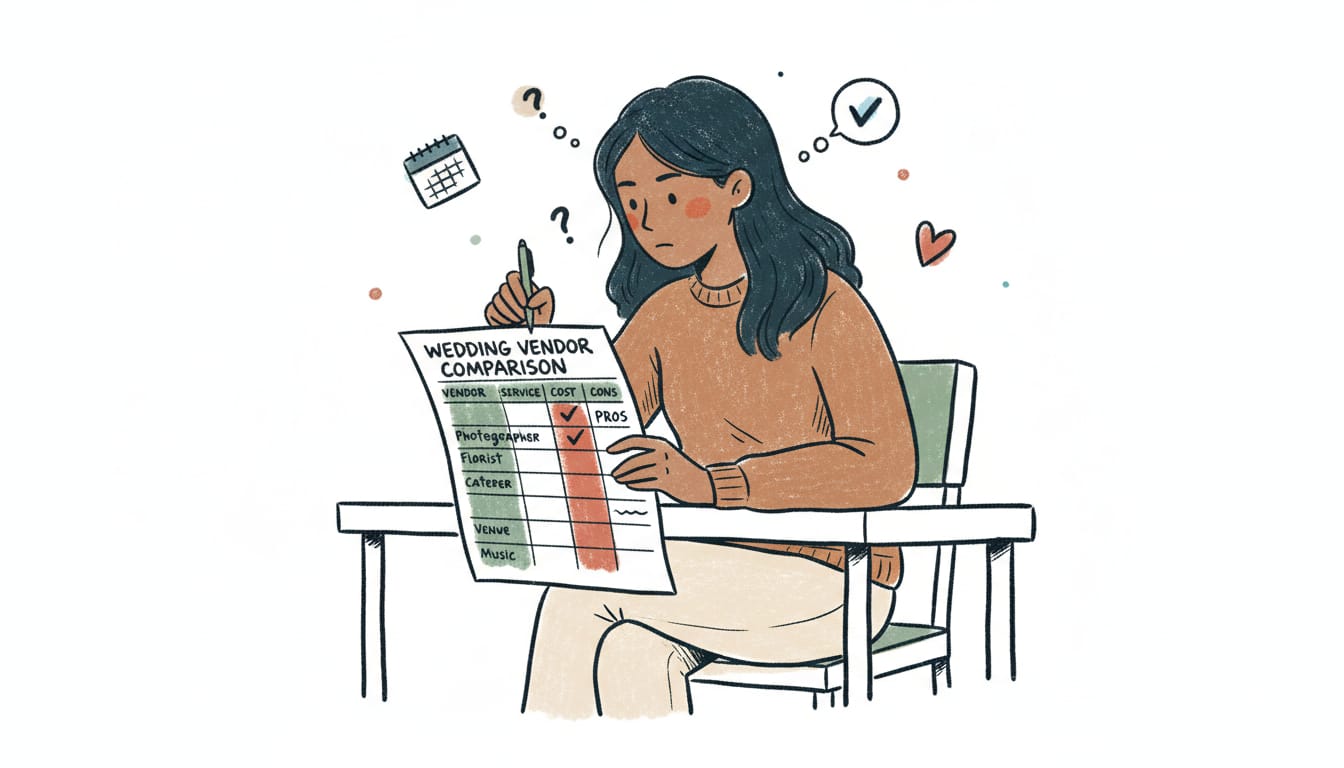
You've reached out to wedding vendors. Now you have five photographer proposals, three catering quotes, and four DJ options. They all look good. They're all professional. And you have no idea how to choose.
Here's the problem: Comparing wedding vendors based only on price leads to buyer's remorse. Comparing based only on vibes leads to missed red flags.
This 5-point framework for how to compare wedding vendors takes the guesswork out of vendor comparison. By the end of this guide on how to compare wedding vendors, you'll have a systematic approach to evaluating vendors and making confident decisions.
Table of Contents
- Why Comparing Vendors Is Overwhelming
- The 5-Point Framework
- How to Create a Comparison Spreadsheet
- What to Prioritize by Vendor Type
- When to Trust Your Gut vs. Data
- FAQ
Why Learning How to Compare Wedding Vendors Is Overwhelming
Most couples struggle when trying to figure out how to compare wedding vendors because:
1. Packages Aren't Standardized
Every photographer's "8-hour package" includes different things. One includes engagement session and second shooter. Another doesn't. How do you compare them?
The fix: Our framework teaches you to break packages down into per-deliverable costs so you can compare apples-to-apples.
2. You're Comparing Subjective Qualities
"I loved their vibe" isn't a decision-making framework. Neither is "Their portfolio is gorgeous." Every vendor you contacted probably has a beautiful portfolio.
The fix: Use objective criteria alongside subjective gut feelings to make balanced decisions.
3. Price Ranges Vary Wildly
Photographer quotes range from $1,500 to $8,000. Caterers quote $45/person to $200/person. Without context, how do you know what's reasonable?
The fix: Understand what affects pricing in each category and evaluate value, not just cost.
4. You're Afraid of Making the Wrong Choice
These vendors are expensive, and you can't do your wedding over if you're unhappy with results. The pressure to choose correctly is intense.
The fix: A systematic framework reduces decision anxiety by giving you clear criteria to evaluate objectively.
The 5-Point Framework: How to Compare Wedding Vendors
Learning how to compare wedding vendors is simple with this framework. Use this approach for every vendor category. Each point gets a score of 1-5, then you total scores to compare objectively.
Point 1: Style & Quality (Portfolio Review)
What you're evaluating: Does their creative style match your vision? Is their work consistently high quality?
How to assess:
Review full portfolios, not just Instagram highlights
- Ask to see 3-5 complete recent weddings (not just their favorite 20 photos)
- Look for consistency across multiple events
- Check if they shoot/work in different lighting conditions and venues
Look for style alignment
- Photography: editing style (bright & airy vs. moody & dramatic), posing approach (candid vs. posed), composition
- Florals: color palette, arrangement style (lush & romantic vs. minimal & modern), use of greenery
- Videography: editing pace (cinematic vs. documentary), music choices, storytelling approach
- Catering: presentation style, plating aesthetics, menu creativity
Assess quality markers
- Photographers: Sharp focus, proper exposure, consistent editing, storytelling ability
- Florists: Flower freshness, arrangement construction, color theory, design cohesion
- Caterers: Plate presentation, ingredient quality, attention to detail
- DJs/Bands: Audio quality in sample videos, energy level, reading the room
Red flags:
- Portfolio shows inconsistent quality (some gorgeous work, some subpar)
- Won't show full galleries or complete projects
- Work doesn't match your aesthetic at all
- Only shows work from 2+ years ago (what have they done recently?)
Scoring guide:
- 5 = Perfect style alignment and exceptional quality
- 4 = Strong style match with high quality
- 3 = Generally aligned style with good quality
- 2 = Some style misalignment or inconsistent quality
- 1 = Poor style match or low quality
Point 2: Availability & Logistics
What you're evaluating: Can they actually fulfill your needs on your date with your logistical requirements?
How to assess:
Confirm hard availability
- They're available your exact date (not "probably" or "let me check")
- No conflicts with other weddings or events
- Can commit to your required hours/timeline
Verify logistical fit
- Serve your venue location (or willing to travel)
- Can accommodate your guest count
- Have worked at your venue before (bonus, not required)
- Can deliver on your timeline (caterers needing kitchen access, florists needing setup time)
Evaluate backup plans
- Photographers/videographers: Backup equipment and backup shooter if they're sick
- Caterers: Backup staff and contingency plans for equipment failure
- DJs/bands: Backup performers if someone is sick
- Hair/makeup: Team size can handle your bridal party in time needed
Red flags:
- Vague about availability ("I think I'm free")
- Double-booking or trying to fit in multiple events on your date
- Location is far from your venue with no travel plan
- No backup plan if they're sick or equipment fails
- Can't accommodate your guest count or timeline
Scoring guide:
- 5 = Confirmed availability with solid backup plans and logistical fit
- 4 = Available with good logistics and basic backup plans
- 3 = Available but some logistical concerns
- 2 = Tentative availability or significant logistics challenges
- 1 = Unavailable or can't meet basic requirements
Point 3: Price & Value (Not Just Cost)
What you're evaluating: What are you getting for the price? Is the value worth the investment?
How to assess:
Break down what's included
Create a comparison for photographers, example:
| Vendor A - $3,500 | Vendor B - $4,200 | Vendor C - $2,800 |
|---|---|---|
| 8 hours coverage | 10 hours coverage | 6 hours coverage |
| 500 edited photos | 600 edited photos | 300 edited photos |
| Engagement session | No engagement session | Engagement session |
| Second shooter | Second shooter | No second shooter |
| $7/photo | $7/photo | $9.33/photo |
Insight: Vendor B seems most expensive, but offers most coverage. Vendor C is cheapest upfront but highest cost per photo.
Calculate value metrics
- Photography/Video: Cost per hour, cost per edited photo/minute of footage
- Catering: Cost per person, what's included (rentals, service, bar)
- Florals: Cost per arrangement, setup/delivery included
- DJ/Band: Cost per hour, equipment and add-ons included
Evaluate experience premium
- Are you paying more for 15 years of experience vs. 2 years?
- Does that experience matter for your wedding complexity?
- Is the price difference justified by portfolio quality?
Consider value-adds
- Planning assistance from coordinator
- Vendor referrals from planner
- Engagement session from photographer
- Tasting included with catering
- Trial included with hair/makeup
Red flags:
- Vague pricing with lots of "it depends"
- Hidden fees not disclosed upfront (travel, overtime, service charges)
- Prices significantly above or below market rate with no explanation
- Pushy upselling or package switching during consultation
- Won't provide itemized breakdowns
Scoring guide:
- 5 = Exceptional value, transparent pricing, worth the investment
- 4 = Good value for what's included
- 3 = Fair pricing, average value
- 2 = Overpriced for what's offered or hidden fees
- 1 = Poor value or pricing concerns
Point 4: Reviews & Reputation
What you're evaluating: How do they actually perform? What do real clients say?
How to assess:
Read 10-15 recent reviews across multiple platforms
- Google Reviews
- WeddingWire
- The Knot
- Yelp
Look for patterns, not individual complaints
- Green flags: Consistent praise for communication, reliability, quality, professionalism
- Yellow flags: One or two negative reviews among mostly positive (address with vendor)
- Red flags: Multiple reviews citing same issues (late, unprofessional, quality problems)
Pay attention to review timing
- Recent reviews (within 1-2 years) are most relevant
- Vendors evolve—old reviews may not reflect current quality
- Suspicious if ALL reviews are 5 stars with generic praise (could be fake)
Evaluate their responses to negative reviews
- Do they respond professionally?
- Do they take accountability or make excuses?
- Do they offer to make things right?
Ask for references
- Request contact info for 2-3 recent clients with similar weddings
- Ask specific questions: communication style, reliability, quality of work, value
Red flags:
- Multiple reviews mentioning poor communication or unresponsiveness
- Complaints about not delivering promised work
- Reviews citing unprofessional behavior
- Defensive or rude responses to negative feedback
- No reviews at all (how established are they?)
- Won't provide references
Scoring guide:
- 5 = Overwhelmingly positive reviews with consistent themes
- 4 = Mostly positive reviews with strong patterns
- 3 = Mixed reviews or limited review history
- 2 = Concerning negative patterns in reviews
- 1 = Numerous red flags in reviews or reputation concerns
Point 5: Personality & Fit
What you're evaluating: Do you genuinely enjoy working with this person? Do they "get" your vision?
How to assess:
Evaluate communication style
- Responsiveness: Do they reply within 24-48 hours?
- Clarity: Do they answer questions directly or dodge?
- Enthusiasm: Are they genuinely excited about your wedding?
- Professionalism: Friendly but professional boundaries
Assess personality match
- Do you feel comfortable around them?
- Do they listen to your ideas or impose their own?
- Do they ask questions about your vision and priorities?
- Can you see yourself spending 8+ hours with them on your wedding day?
Test problem-solving approach
- Ask a "what if" question: "What if it rains?" or "What if we run late?"
- Do they have thoughtful solutions?
- Are they flexible or rigid?
- Do they collaborate or dictate?
Gauge excitement for your vision
- Do they light up when you describe your wedding?
- Do they offer creative ideas that align with your style?
- Do they reference your specific wedding details or give generic responses?
Trust your gut
- Do you feel confident in their abilities?
- Do you trust them to execute your vision?
- Do you feel heard and respected?
Red flags:
- Slow to respond or frequently unresponsive
- Talks over you or dismisses your ideas
- Seems unenthusiastic or distracted
- Pushes their vision instead of listening to yours
- Makes you feel uncomfortable or talked down to
- You have a nagging feeling something is "off"
Scoring guide:
- 5 = Excellent communication, perfect personality fit, very excited to work together
- 4 = Good communication and personality fit
- 3 = Acceptable fit but not particularly excited
- 2 = Communication or personality concerns
- 1 = Poor fit or significant communication issues
How to Create a Wedding Vendor Comparison Spreadsheet
A comparison spreadsheet takes emotion out of decision-making and lets you see all criteria side-by-side.
Template Structure
Create a spreadsheet with these columns:
| Vendor Name | Style/Quality (1-5) | Availability (1-5) | Price/Value (1-5) | Reviews (1-5) | Personality (1-5) | Total Score | Notes |
|---|---|---|---|---|---|---|---|
| Vendor A | |||||||
| Vendor B | |||||||
| Vendor C |
Example: Comparing Photographers
| Vendor Name | Style (1-5) | Availability (1-5) | Price/Value (1-5) | Reviews (1-5) | Personality (1-5) | Total | Notes |
|---|---|---|---|---|---|---|---|
| Sarah Photo Co | 5 | 5 | 4 | 5 | 5 | 24/25 | Loved her energy, perfect style match, great value |
| John Smith Photo | 4 | 5 | 5 | 4 | 3 | 21/25 | Good work but less connected personally |
| Emily's Photography | 5 | 4 | 3 | 4 | 4 | 20/25 | Beautiful work but over budget |
Result: Sarah Photo Co scores highest (24/25). She's the clear choice despite not having the absolute lowest price.
When Scores Are Close
If two vendors tie or are within 2 points:
- Re-weight based on priorities: If photography is your #1 priority, double the Style/Quality score
- Use tie-breakers:
- Who responded faster and more thoroughly?
- Who has more experience at your venue?
- Who offered more value-adds?
- Who are you genuinely more excited to work with?
- Trust your gut: If all else is equal, choose the vendor you're most excited about
What to Prioritize by Vendor Type
Not all criteria matter equally for every vendor type. Here's how to weight the 5-point framework:
Creative Vendors (Photographer, Videographer, Florist)
Most important: Style & Quality (40%), Reviews (25%) Medium importance: Personality & Fit (20%), Price & Value (10%) Less critical: Availability (5%)
Why: You'll live with these creative outputs forever. Style alignment and quality matter most. If your top photographer is slightly over budget, consider reallocating from less critical categories.
Service Vendors (Caterer, Coordinator, Hair/Makeup)
Most important: Reviews (30%), Personality & Fit (30%) Medium importance: Price & Value (20%), Availability (15%) Less critical: Style & Quality (5%)
Why: These vendors manage logistics and interact with you closely. Reliability, communication, and trust are paramount.
Entertainment (DJ, Band)
Most important: Personality & Fit (35%), Reviews (30%) Medium importance: Style & Quality (20%), Price & Value (10%) Less critical: Availability (5%)
Why: Your DJ/band sets the energy for your reception. You need someone who reads the room well, communicates clearly, and can adapt on the fly.
Venue
Most important: Availability (30%), Style & Quality (25%), Price & Value (25%) Medium importance: Reviews (15%) Less critical: Personality & Fit (5%)
Why: Your venue determines your date, capacity, and aesthetic. Logistical fit is critical. Personality matters less because you'll work with them minimally.
When to Trust Your Gut vs. Data
Trust the Data When:
- Your gut feeling is based on excitement over one pretty Instagram photo
- You're tempted to book the cheapest option without comparing value
- A vendor scored poorly on objective criteria (reviews, availability) but you "like their vibe"
- You're choosing between vendors you've never met (use the framework)
- Family or friends are pressuring you toward a specific vendor
Example: "I love Sarah's Instagram, but her reviews mention missed deliveries and she scored 12/25 on the framework. The data says move on."
Trust Your Gut When:
- Two vendors score nearly identically on the framework (within 2 points)
- A vendor checks all boxes on paper but something feels off
- You have a strong positive feeling about a vendor who scores slightly lower
- You've met all candidates and one just "clicked"
- Your gut is saying "this person will make my day less stressful"
Example: "Vendor A scored 23/25 and Vendor B scored 22/25. Both are excellent, but I genuinely loved talking to Vendor B and can see us being friends. Going with Vendor B."
The Balance
Use the 5-point framework to narrow to your top 2-3 finalists. Then use gut feeling to make the final call among those top choices.
Don't: Ignore glaring red flags because you like someone's personality Do: Choose the vendor who scores well and makes you feel confident and excited
Common Vendor Comparison Mistakes
Mistake #1: Comparing Only on Price
The problem: Cheapest option often means less experience, fewer deliverables, or corner-cutting.
Example: Photographer A charges $2,000 for 4 hours and 200 photos. Photographer B charges $3,500 for 8 hours and 600 photos. On a per-photo basis, B is better value.
The fix: Calculate cost per deliverable and evaluate total value.
Mistake #2: Choosing Based on One Amazing Photo
The problem: Every photographer has 5-10 portfolio-perfect images. Can they deliver that quality consistently?
Example: You fall in love with one stunning sunset photo, but their full galleries show inconsistent editing and missed moments.
The fix: Always review full wedding galleries from 3-5 recent events.
Mistake #3: Ignoring Red Flags Because You're Tired
The problem: Decision fatigue makes you overlook warning signs just to check "booked" off your list.
Example: A florist's reviews mention missing flowers and poor communication, but you're exhausted from searching and their price is right.
The fix: Take a break. Better to book the right vendor a week later than the wrong vendor today.
Mistake #4: Letting Others Make Your Decision
The problem: Family/friends push you toward vendors they know, even if those vendors don't fit your vision.
Example: Your aunt insists you use her photographer friend, but their style is completely wrong for your aesthetic.
The fix: Thank them for the recommendation, add that vendor to your list, and evaluate objectively using the framework.
Mistake #5: Booking Before Meeting All Your Top Choices
The problem: You fall in love with the first vendor you meet and book immediately, missing potentially better options.
Example: You meet Vendor A on Monday and book Tuesday. Then you meet Vendor B on Thursday who's actually a better fit and value.
The fix: Schedule all consultations within the same 1-2 week period, then compare and decide.
Mistake #6: Not Reading Contracts Carefully
The problem: You skim contracts and miss important details about deliverables, cancellation policies, or payment terms.
Example: You thought you'd get 600 photos but the contract says "up to 400." The vendor is delivering exactly what they promised—you just didn't read carefully.
The fix: Read every contract thoroughly. Ask questions about anything unclear. Consider having a lawyer review big-ticket contracts.
Everly's Vendor Comparison Tools
Manually comparing vendors across all these criteria is time-consuming. Everly's AI-powered platform automates vendor comparison:
Smart Vendor Matching
Our AI considers:
- Your style preferences (learned from vendors you save)
- Your budget range
- Your wedding date and location
- Your priorities by category
Result: You only see vendors who are genuine matches, not every photographer in a 50-mile radius.
Automatic Comparison Views
Everly creates comparison charts showing:
- Side-by-side package breakdowns
- Cost per deliverable calculations
- Aggregated review scores
- Availability confirmation
- Vendor response speed
Result: All comparison data in one place, no spreadsheet needed.
Communication Tracking
Track all vendor conversations:
- Which vendors you've contacted
- Response times
- Questions asked and answered
- Follow-up reminders
Result: Never lose track of where you are with each vendor.
Try Everly's Vendor Comparison Tools →
Quick Decision-Making Checklist
Before booking any vendor, confirm:
- Reviewed full portfolio/work samples from 3-5 recent projects
- Confirmed hard availability for your date
- Verified they serve your venue location
- Received itemized pricing breakdown
- Read 10-15 recent reviews across multiple platforms
- Checked references or testimonials
- Had consultation call/meeting
- Received and reviewed full contract
- Scored them on the 5-point framework
- Compared at least 3 vendors in this category
- Feel confident and excited about this choice
- Confirmed payment schedule and cancellation policy
If you can't check all boxes, you're not ready to book. Take more time.
Frequently Asked Questions
How many wedding vendors should I compare before making a decision?
Contact 3-5 vendors per category. This gives you enough options to compare pricing and style without overwhelming yourself. If your top 3 choices are all booked or out of budget, reach out to 2-3 more.
Should I choose the cheapest wedding vendor?
No. Choose the vendor offering the best value for your priorities. The cheapest option often cuts corners on experience, quality, or deliverables. Compare what's included in packages and evaluate cost per deliverable, not just total price.
What if I love a vendor but they're over budget?
Ask if they offer smaller packages or alternative options. Some photographers offer fewer hours or less coverage. Caterers might have budget-friendly menu options. If there's no flexibility and they're significantly over budget (20%+), move on to vendors within your range.
How important are wedding vendor reviews?
Very important. Reviews reveal how vendors actually perform, not just how their portfolio looks. Read 10-15 recent reviews and look for patterns. One bad review isn't a dealbreaker, but multiple complaints about the same issue (communication, timeliness, quality) is a red flag.
What if two vendors seem equally good?
Use tie-breakers: Who responded faster? Whose communication style do you prefer? Who has more experience at your venue or with your wedding style? Who offered more value-adds? Trust your gut—who are you genuinely more excited to work with?
Should I tell vendors I'm comparing multiple options?
Yes, it's professional to mention you're considering a few options and will make a decision by a specific date. Don't pit vendors against each other on price, but being transparent shows you're a serious, organized client.
How do I compare vendors when packages include different things?
Create a comparison spreadsheet listing exactly what each vendor includes (hours, deliverables, add-ons). Calculate cost per hour or cost per deliverable to compare apples-to-apples. Sometimes a higher-priced package offers better value.
What vendor qualities matter most?
For all vendor types: reliability, communication, professionalism, and personality fit. For creative vendors (photo/video/florals): style alignment and portfolio quality. For service vendors (catering/coordination): experience and problem-solving skills.
Can I negotiate wedding vendor prices?
You can ask if there's flexibility, especially for off-season dates or if you're booking multiple services. Don't aggressively haggle or demand matching competitor pricing. Respect that vendors know their worth. If someone's out of budget, find vendors in your range rather than pressuring for discounts.
Should I always book the most expensive vendor?
No. Price doesn't always equal quality. A vendor charging premium prices might have overhead costs, not necessarily better work. Evaluate value: experience, deliverables, fit, and reviews. Sometimes mid-range vendors offer better value for your specific needs.
Ready to Learn How to Compare Wedding Vendors Confidently?
Now you know how to compare wedding vendors using our 5-point framework. You can evaluate wedding vendors objectively and make decisions you feel great about.
Next steps:
- Download our comparison spreadsheet template to start evaluating vendors systematically
- Review your current vendor shortlist using the 5-point framework
- Use proven email templates to ask the right questions during vendor consultations
- Try Everly's comparison tools to automate vendor evaluation
Browse Wedding Vendors - Find and compare vendors by category →
Download Vendor Email Templates - Ask the right questions →
Complete Vendor Checklist - Know which vendors you need →
About the Author: The Everly Team builds AI-powered tools that make wedding planning less stressful and more joyful.
Wedding Vendor Email Templates for Every Vendor Type
Get faster, clearer vendor replies with 10+ email templates for every vendor type, plus the five details every inquiry needs and when to follow up.
Wedding Vendor Contract Red Flags: 12 Clauses to Check Before You Sign
Before you sign a wedding vendor contract, check these 12 clauses. Learn which terms protect you, which are genuine red flags, and how to ask for changes.
Wedding Vendor Checklist: Complete Guide for Every Category (2025)
The ultimate wedding vendor checklist with 12+ categories, booking timelines, budget breakdowns, and questions to ask. Know exactly which vendors you need and when to book them.