How to Plan a Wedding in 6 Months (Without Losing Your Mind)
Planning a wedding in 6 months is possible—and can actually reduce stress. This complete 6-month wedding timeline breaks down exactly what to do each month, what to prioritize, and what to skip.
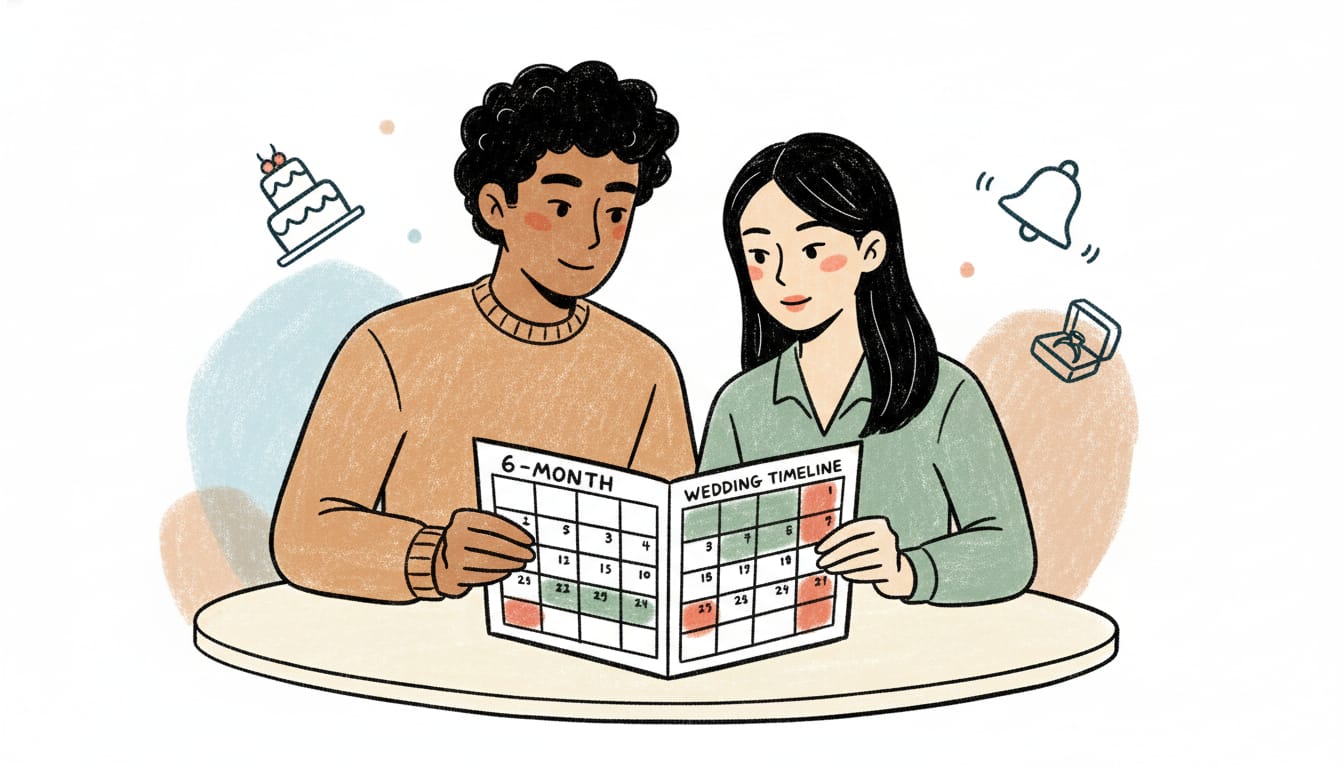
You got engaged. Congrats! Now everyone's asking when the wedding is, and you're thinking... soon. Maybe you don't want a long engagement. Maybe you found the perfect venue with a date 6 months out. Maybe you just want to be married already.
Then someone inevitably says: "You can't plan a wedding in 6 months! You need at least a year!"
Here's the truth: You can absolutely plan a beautiful, meaningful wedding in 6 months. The key isn't more time—it's more focus.
This guide breaks down exactly how to plan a wedding in 6 months: month-by-month priorities, what to book first, what to skip entirely, and how to stay sane through the process.
Table of Contents
- Is 6 Months Really Enough Time?
- What Makes 6-Month Planning Different
- Month-by-Month Timeline
- What to Prioritize First
- What to Skip or Simplify
- How to Stay Sane
- 6-Month Wedding Examples
- FAQ
Is 6 Months Really Enough Time?
Yes. With two important caveats:
1. You'll need to make decisions faster. Not rushed—just decisive. You can't spend three weeks debating invitation fonts. Research three options, pick one, move on.
2. You'll need some flexibility. Your dream photographer might be booked. The venue you saw on Instagram might not have availability. But "your dream wedding" doesn't require those specific vendors—it requires great vendors who get your vision.
The average couple spends 12-18 months planning a wedding. Know what happens in that extra 6-12 months? Mostly stress, second-guessing, and adding unnecessary complications.
A compressed timeline can actually reduce stress by forcing you to focus on what matters and skip what doesn't.
What Makes 6-Month Planning Different
Speed Over Perfection
You're not searching for the objectively perfect caterer. You're finding a great caterer with availability who fits your budget and style. That's enough.
Decisions in Days, Not Weeks
Set yourself a 48-hour decision deadline. Research vendors on Monday and Tuesday, schedule calls Wednesday and Thursday, make decision by Friday. Book by weekend. Repeat.
Ruthless Prioritization
Every decision gets filtered through: Does this significantly impact our guest experience or our memories?
If yes, invest time. If no, use a template, buy it ready-made, or skip it entirely.
Vendor Availability Dictates Some Choices
With 18 months to plan, you can book any photographer. With 6 months, you book the best available photographer. That's not settling—that's being realistic about timing.
Month-by-Month Wedding Planning Timeline
Month 6-5: Foundation (Weeks 1-8)
Primary Goal: Lock in venue and essential vendors
Week 1-2: Venue Hunt
- Determine budget and guest count (rough estimates fine)
- Identify 5-7 venues with availability in your timeframe
- Schedule venue tours (try to knock out 3-4 in one weekend)
- Book your venue by end of week 2 if possible
Why this matters: Your venue determines your date, capacity, location, aesthetic, and often catering. Nothing else can be finalized until this is locked.
Pro tip: Ask venues about recent cancellations. A Saturday 6 months out that just opened up is a gift.
Week 3-4: Essential Vendor Blitz
Once venue is booked, immediately reach out to:
- Photographers (top 3-5 with availability)
- Catering (if not included with venue)
- DJ or Band (entertainment books fast)
Send inquiry emails to all on the same day. Schedule calls within one week. Make decisions within two weeks.
Sample timeline: Reach out Monday, calls Tuesday-Thursday, second meetings Friday-Saturday if needed, decisions and contracts by following Tuesday.
Week 5-8: Lock Essential Vendors
- Book photographer (by week 5)
- Book catering (by week 6)
- Book entertainment - DJ or band (by week 6-7)
- Start researching florist, hair/makeup, officiant
What you should have by end of Month 5:
- Venue booked
- Photographer booked
- Catering confirmed
- Entertainment booked
- Rough guest list (within 20% of final count)
Month 4: Guest List and Invitations (Weeks 9-12)
Primary Goal: Get invitations out
Traditionally, invitations go out 6-8 weeks before the wedding. You're sending them earlier because you need RSVPs faster.
Week 9-10: Finalize Guest List
- Create actual guest list with addresses
- Set your guest count ceiling
- Have the hard conversations about who's invited
- Collect mailing addresses
Week 11-12: Invitations
- Order invitations (or use digital invites to save 2-3 weeks)
- Set up wedding website with details
- Create registry
- If doing paper invites, order them by week 11 to ship by week 12-13
Digital invitation option: Services like Paperless Post or Greenvelope get invites out in days, not weeks, and tracking RSVPs is automatic. No shame in going digital for a short timeline.
What you should have by end of Month 4:
- Complete guest list
- Invitations ordered or sent (digital)
- Wedding website live
- Registry created
Month 3: Remaining Vendors (Weeks 13-16)
Primary Goal: Book all remaining vendors
Week 13-14: Floral and Beauty
- Research and book florist
- Book hair and makeup artist
- Schedule hair/makeup trial (month 2)
Week 15-16: Final Vendor Categories
- Book wedding cake/desserts
- Book officiant (or confirm friend getting ordained)
- Book day-of coordinator if budget allows
- Book transportation if needed
- Book any specialty vendors (videographer, photo booth)
What you should have by end of Month 3:
- All major vendors booked
- Vendor payment schedules organized
- Initial vendor communications established
Month 2: Details and Design (Weeks 17-20)
Primary Goal: Make all the little decisions
This is where planning gets dense. You're finalizing logistics, design choices, and day-of details.
Week 17: Ceremony Details
- Write or review ceremony script with officiant
- Choose ceremony music
- Plan ceremony processional order
- Decide on readings, vows, rituals
Week 18: Reception Details
- Create reception timeline with DJ/band
- Choose first dance and parent dance songs
- Plan toasts and speeches order
- Finalize menu with caterer
Week 19: Design and Rentals
- Finalize floral design and quantities
- Choose rental items (if needed beyond venue offerings)
- Order wedding favors if doing them
- Order any signage, programs, menus
Week 20: Attire and Trials
- Final dress fitting (if alterations needed, start this month 3)
- Finalize partner's attire
- Schedule and complete hair/makeup trial
- Break in wedding shoes
What you should have by end of Month 2:
- Complete ceremony and reception timeline
- All design decisions finalized
- Attire ready
- Day-of logistics planned
Month 1: Weeks 21-24 (Finalize Everything)
Primary Goal: Confirm, confirm, confirm
Week 21: Guest Count Finalization
- Chase down missing RSVPs
- Finalize guest count
- Confirm numbers with caterer, venue, rental company
- Create seating chart
Week 22: Vendor Confirmations
- Send final timeline to all vendors
- Confirm arrival times and setup details
- Verify vendor contact info (cell phones for day-of)
- Confirm delivery addresses and timing
Week 23: Legal and Logistics
- Get marriage license (check your state's timing requirements)
- Confirm honeymoon plans if traveling
- Finalize tip envelopes for vendors
- Create day-of emergency kit
Week 24: Final Week
- Final venue walkthrough
- Rehearsal and rehearsal dinner
- Distribute vendor payments and tips
- Pack for wedding night and honeymoon
- Confirm transportation for wedding day
- Take a breath. You're done planning. Now get married.
What to Book First for a 6-Month Wedding
If you can only book three vendors in your first month, make them these:
1. Venue (Week 1-2)
Everything else depends on this. No exceptions.
2. Photographer (Week 3-4)
Good photographers book 12-18 months out for peak dates. If photography matters to you, this is your second priority. Many couples say photography is the #1 thing they wish they'd prioritized more.
3. Catering (Week 4-5)
Whether it's the venue's in-house catering or an outside caterer, this is usually your largest single expense and needs to be locked early.
After these three, book in this order: 4. Entertainment (DJ/band) 5. Florist 6. Hair/Makeup 7. Cake 8. Day-of coordinator 9. Specialty vendors (videographer, transportation, etc.)
What to Skip or Simplify
You can't do everything in 6 months. Here's what to cut without regret:
Skip Entirely:
- Elaborate DIY projects: Those 150 hand-painted escort cards? Buy them ready-made or skip escort cards entirely.
- Engagement photo session: Use existing photos of you two for save-the-dates or website.
- Custom everything: Off-the-rack dress, standard invitation templates, caterer's existing menu options. Custom takes time you don't have.
- Large wedding party: More people means more coordination, more opinions, more attire to wrangle. Keep it small.
- Multi-day events: Welcome party, day-after brunch, multiple showers. Focus energy on the main event.
Simplify:
- Invitations: Use online services with templates, or go digital entirely.
- Florals: Choose seasonal flowers and let florist design within budget rather than specifying every bloom.
- Favors: Skip them or choose something simple (cookies from a local bakery, matchbooks, mini succulents).
- Programs: Put ceremony info on your wedding website instead of printing programs.
- Save-the-dates: Just send invitations early (3-4 months out) instead of save-the-dates + invitations.
What you absolutely should NOT skip:
- Photographer (you'll have these images forever)
- Good food (guests remember bad food)
- Reliable vendors (you can't afford day-of disasters with tight timeline)
- Day-of coordinator (unless your venue includes one)
How to Stay Sane Planning in 6 Months
1. Set Planning Boundaries
Don't: Plan every waking moment for 6 months straight.
Do: Set specific planning time. "Tuesday and Thursday evenings, 7-9pm, and Sunday afternoons." Outside those times, you're living your life.
2. Use the 48-Hour Decision Rule
Research your options. Schedule calls or meetings. Set a decision deadline 48 hours out. When the deadline hits, decide. No more research. No more "let me think about it."
Indecision kills momentum on short timelines.
3. Batch Similar Tasks
Don't send vendor emails one at a time over three weeks. Block 2 hours, send all venue inquiries in one session. Block another 2 hours later that week, send all photographer inquiries.
Batching creates efficiency and maintains momentum.
4. Limit Your Research
Search for "wedding photographers [your city]" returns thousands of results. You don't have time for thousands.
The rule: Research 5-7 vendors per category maximum. Pick your top 3. Reach out to all 3. Book one. Move on.
5. Steal, Don't Reinvent
Use email templates for vendor inquiries. Use existing ceremony scripts and modify them. Copy seating chart formats. Use your venue's preferred vendor list.
This isn't lack of creativity—it's efficiency.
6. Delegate Ruthlessly
Your partner, wedding party, family, and friends can help. Let them.
Tasks to delegate:
- Researching vendors (give them criteria, they send you top 3)
- Collecting addresses for guest list
- DIY projects if you're doing any
- Day-of setup and breakdown
- Managing RSVPs
- Creating Spotify playlists
7. Use AI and Automation
Vendor email taking 20 minutes to craft? Use AI to draft responses based on your conversation history.
Need to compare three caterers' quotes? Generate a comparison report from your email threads instead of building a spreadsheet.
Learn more about AI-powered wedding planning tools that save hours of coordination time.
8. Protect Your Relationship
Planning stress can bleed into your relationship. Prevent this:
- Schedule regular non-wedding date nights
- Set a "no wedding talk after 9pm" rule
- Make major decisions together, but divide and conquer on execution
- Remember you're planning a marriage, not just a wedding
9. Know When to Spend vs. Save Time
Spend time on: Vendor research for photographer, venue, catering (these make or break your day)
Don't spend time on: Agonizing over napkin colors, debating invitation font for a week, hand-making anything you could buy
Spend money to save time: Day-of coordinator, done-for-you invitations, ready-made decor
6-Month Wedding Examples
These are composite examples, not specific couples.
October Wedding, Planned April-October
The situation: Got engaged in April, found a venue with a cancellation for October. Didn't want to wait another year.
What worked:
- Booked venue, photographer, and caterer in the first 3 weeks
- Used venue's preferred vendor list for florist and DJ (saved research time)
- Sent digital invitations through Paperless Post
- Kept wedding party to just maid of honor and best man
The lesson: Say yes to the first vendor in each category who fits your budget and vibe. A short runway rewards decisiveness.
Intimate Wedding, 6-Month Timeline
The situation: Planned a 40-person wedding in 6 months at a restaurant.
What worked:
- Restaurant venue meant catering was included
- Skipped most traditional vendors (no DJ, minimal florals, no formal invitations)
- Focused budget on photographer and food
- Made it feel special through personal details, not vendor services
The lesson: Name your non-negotiables first, such as great food, great photos, and your favorite people. Everything else is optional.
Budget-Conscious 6-Month Wedding
The situation: Tight budget, short timeline, wanted a real wedding feel with 100 guests.
What worked:
- Off-season date (February) meant better vendor availability and pricing
- Booked newer vendors building their portfolios
- Simplified florals to seasonal greenery and white flowers
- Friends handled music with Spotify playlists
- Spent money on things guests would remember: food, drinks, photos
The lesson: A short timeline can help your budget. There's no time to add the extras you'd talk yourselves into with more time.
Month-by-Month Checklist Download
Want a printable checklist to track your 6-month wedding planning timeline?
Download the Free 6-Month Wedding Planning Timeline →
Includes:
- Week-by-week task breakdown
- Vendor booking order and timing
- Budget allocation worksheet
- Decision deadline tracker
- Vendor contact organizer
- Month-by-month checklists
Frequently Asked Questions
Is 6 months enough time to plan a wedding?
Yes, 6 months is enough time to plan a beautiful wedding if you're organized and decisive. The key is prioritizing essential vendors (venue, catering, photographer, entertainment) immediately and being flexible on details. Many vendors have availability within 6 months, especially for off-peak dates or weekdays.
What's the biggest challenge of planning a wedding in 6 months?
Vendor availability. Popular photographers, venues, and planners often book 12-18 months out for peak season weekends. However, you can find excellent vendors with shorter notice by: being flexible on dates (Fridays/Sundays have better availability), considering off-season months, looking for newer vendors building their portfolios, or choosing vendors who had recent cancellations.
Should I hire a wedding planner for a 6-month timeline?
A planner can be incredibly valuable for short timelines. They have vendor relationships, know who has availability, and can compress the decision-making process. However, if budget is tight, consider a day-of coordinator instead (book them month 4-5) and use planning tools to stay organized yourself.
What's the first thing I should book for a 6-month wedding?
Venue. Your venue determines your date, guest capacity, location, and often dictates catering options. Book this in your first two weeks if possible. Once you have a venue and date, immediately reach out to photographer, catering (if not venue-provided), and entertainment—these are the next vendors most likely to book up.
Can I plan a wedding in 6 months on a budget?
Absolutely. Shorter timelines can actually help with budget because: you have less time to add unnecessary expenses, vendors sometimes offer discounts for last-minute availability, you'll focus on essentials rather than getting distracted by every detail, and you can take advantage of off-season pricing if your timeline falls in November-March.
What can I skip or simplify when planning in 6 months?
Skip or simplify: elaborate stationery (use digital invites or simple designs), complicated DIY projects (buy ready-made instead), large wedding party (fewer people means less coordination), custom designs (choose from existing options), engagement photos (use existing photos for save-the-dates), and multi-day events (focus energy on the main day).
How do I avoid getting overwhelmed planning a wedding in 6 months?
Stay sane by: making decisions quickly (set 48-hour decision deadlines), limiting options (research 3-5 vendors per category, not 20), delegating tasks to wedding party and family, using templates for emails and planning, saying no to unnecessary details, and protecting your time (set specific planning hours, not all-day every-day).
Is a 6-month timeline better for destination weddings?
Not typically. Destination weddings usually need 12-18 months for guest travel planning and booking accommodations. However, if you're planning a very small destination wedding (10-20 guests) or a local micro-wedding that feels like a destination, 6 months can work.
What months are easiest for 6-month wedding planning?
Off-season months (November-March, excluding holidays) offer the best vendor availability for short timelines. If you're starting planning in May, aiming for a November wedding gives you more options than aiming for an October peak-season date.
How do I keep track of everything with such a short timeline?
Use a centralized planning system—whether that's a detailed spreadsheet, planning app, or AI-powered tool like Everly. You need one place where all vendor communications, contracts, payments, and decisions live. With 6 months, you can't afford to lose track of details.
Can I still have my dream wedding with only 6 months to plan?
Yes, but you'll need to adjust expectations on some specifics. You can absolutely have a beautiful, meaningful, joyful wedding. The dream might include different flowers than you originally envisioned, or a different photographer than your first choice. Focus on the elements that matter most to you and be flexible on the rest.
What if vendors say they're booked for my date?
Ask if they have associates or can recommend similar vendors. Check if they have availability on nearby dates (Friday/Sunday instead of Saturday). Look for vendors who recently had cancellations—many vendors post last-minute availability on Instagram or their websites.
Ready to Plan Your 6-Month Wedding?
Six months is enough. You don't need a year to plan a beautiful, meaningful wedding. You need focus, decisiveness, and the right tools to stay organized.
Your next steps:
- Download the 6-month timeline checklist to track your progress
- Use the timeline calculator to get your personalized week-by-week schedule
- Start with venue research this week—don't wait
- Set up your planning system (spreadsheet, app, or AI tool)
Try Everly's AI Planning Tools - Get vendor email templates, automated responses, and planning timeline in one place →
Download 6-Month Timeline Checklist - Track your progress week by week →
Read: Wedding Vendor Checklist - Know exactly which vendors you need →
About the Author: The Everly Team builds AI-powered tools that make wedding planning less stressful and more joyful.
How Much Does a Full-Service Wedding Planner Cost in 2026?
Full-service wedding planners cost $3,000-$12,000+ or 10-20% of your budget. See real price ranges, what full-service includes, and a cheaper AI alternative.
Can You Plan a Wedding Without a Wedding Planner? (Yes — Here's How)
Yes, you can plan a wedding without a planner. Here is the exact system—tools, timeline, and an AI agent—to do the vendor busywork and stay organized.
Wedding Planning Spreadsheet vs Apps vs AI: Which Actually Saves Time?
Spreadsheets, traditional planning apps, or AI-powered platforms? Compare costs, tradeoffs, and which wedding planning tool fits your planning style.